
Assessing drug efficacy in preclinical animal studies requires more than observing whether a treatment improves a disease-related outcome. Research teams must determine whether a candidate produces measurable, reproducible biological effects and whether the findings justify further development.
For research and development (R&D) directors, a well-designed study connects a biological hypothesis with measurable outcomes. A preclinical contract research organization (CRO) can coordinate animal models, pharmacodynamic measurements, pharmacokinetic analysis, and safety assessments before clinical testing.

How Is Drug Efficacy Assessed in Preclinical Animal Studies?
Drug efficacy is assessed by comparing predefined outcomes between treated animals and appropriate control groups in a relevant disease model. Researchers select endpoints that reflect the drug’s intended mechanism and therapeutic objective.
What Is the Purpose of Preclinical Efficacy Studies?
Preclinical efficacy studies determine whether a drug candidate produces the intended biological or therapeutic effect under controlled conditions. They help researchers evaluate a candidate before exposing human participants to it.
For example, an oncology candidate may be assessed by measuring tumor volume, while an anti-inflammatory compound may be evaluated using disease-related scores or biomarkers. The endpoint depends on the indication and mechanism of action. A treatment effect supports further investigation but does not establish that the drug will work in humans.
How Do Efficacy, Pharmacodynamics, and Safety Differ?
These assessments answer different questions and should be interpreted together. Efficacy asks whether the treatment produces the intended effect, such as reduced tumor growth. Pharmacodynamics (PD) examines biological changes caused by the drug, such as inhibition of a target pathway. Pharmacokinetics (PK) examines how drug exposure changes over time, often through plasma concentration measurements. Toxicology evaluates potential adverse effects, including clinical signs or organ changes.
Together, these findings help researchers distinguish a candidate that lacks activity from one that reaches its target but causes unacceptable toxicity.
| Assessment | Question answered | Example |
| Efficacy | Does the treatment produce the intended effect? | Reduced tumor growth |
| Pharmacodynamics (PD) | What biological changes occur? | Target-pathway inhibition |
| Pharmacokinetics (PK) | What is the drug exposure over time? | Plasma concentrations |
| Toxicology | What adverse effects may occur? | Clinical signs or organ changes |
Which Methods Are Used to Measure Drug Efficacy in Animal Models?
Researchers measure efficacy using endpoints that connect the treatment’s intended mechanism to observable biological changes. Methods depend on the disease, drug mechanism, and stage of development.

Which Biological and Disease-Related Endpoints Should Researchers Measure?
The primary endpoint should reflect the study’s main hypothesis and be defined before experiments begin. Secondary endpoints provide supporting evidence about the treatment response.
Common measurements include tumor growth inhibition, disease-severity scores, biomarkers associated with the drug’s target, and—when appropriate—survival or disease progression. For example, a metabolic-disease study might measure blood glucose alongside body weight and biochemical markers. These measures can help distinguish a direct treatment effect from changes associated with weight loss or other factors.
How Do Imaging, Biomarkers, and Histopathology Support Efficacy Assessment?
Imaging and tissue analysis help researchers understand where a treatment produces an effect and how it relates to disease biology. Imaging can track changes over time; histopathology examines tissue structure, while immunohistochemistry can identify specific proteins or cellular markers.
These methods are useful when a single measurement cannot explain the response. Reduced tumor volume, for example, may coincide with changes in tumor-cell proliferation or cell death, providing additional evidence of biological activity.
How Does Pharmacokinetic Data Help Explain Treatment Responses?
PK data help researchers determine whether a drug achieves sufficient exposure to plausibly produce its observed effects. Measurements may include plasma concentrations over time and, when relevant, drug levels in target tissues.
Limited efficacy may reflect weak biological activity, inadequate exposure, or both. Comparing exposure with pharmacodynamic responses helps researchers investigate these possibilities and interpret dose-response relationships.
How Can Researchers Design Reliable Preclinical Efficacy Studies?
Reliable studies require a relevant animal model, prespecified endpoints, appropriate controls, and transparent statistical analysis. Otherwise, an apparent treatment effect may reflect bias, biological variability, or an unsuitable design. The ARRIVE Guidelines 2.0 provide recommendations for study design and transparent reporting.
How Should Researchers Select Animal Models and Control Groups?
Researchers should select a model that reproduces disease features relevant to the drug’s intended mechanism. No animal model necessarily captures every aspect of a human disease.
A study may include a vehicle-control group and treatment groups receiving different doses. A positive-control group may be appropriate when an established treatment exists. Define dosing schedules, measurement times, inclusion criteria, and exclusion rules in advance, and consider how model limitations affect translation to human biology.
Why Are Randomization, Blinding, and Sample Size Important?
Randomization reduces systematic differences between groups, while blinding can limit bias during outcome assessment. Sample size should be justified using the expected effect, variability, study design, and planned analysis.
Researchers should define the primary endpoint and success criteria; justify animal numbers; randomize allocation where appropriate; blind assessors when feasible; prespecify statistical methods and exclusions; and report adverse findings alongside efficacy results.
Teams must follow applicable animal-welfare and study-quality requirements. For U.S. investigational drug development, the Food and Drug Administration (FDA) describes the role of preclinical safety evidence and Good Laboratory Practice requirements for applicable nonclinical laboratory studies.
Study-design checklist
- Define primary endpoints and success criteria before the experiment.
- Justify sample size and prespecify the analysis plan.
- Use randomization and blinding where appropriate.
- Report efficacy findings, adverse observations, and study limitations.
How Can KCI BioTech Support Preclinical Efficacy Studies?
A preclinical CRO can coordinate research services so teams evaluate efficacy alongside pharmacological activity, drug exposure, and potential safety concerns. KCI BioTech lists preclinical platforms relevant to these assessment needs.
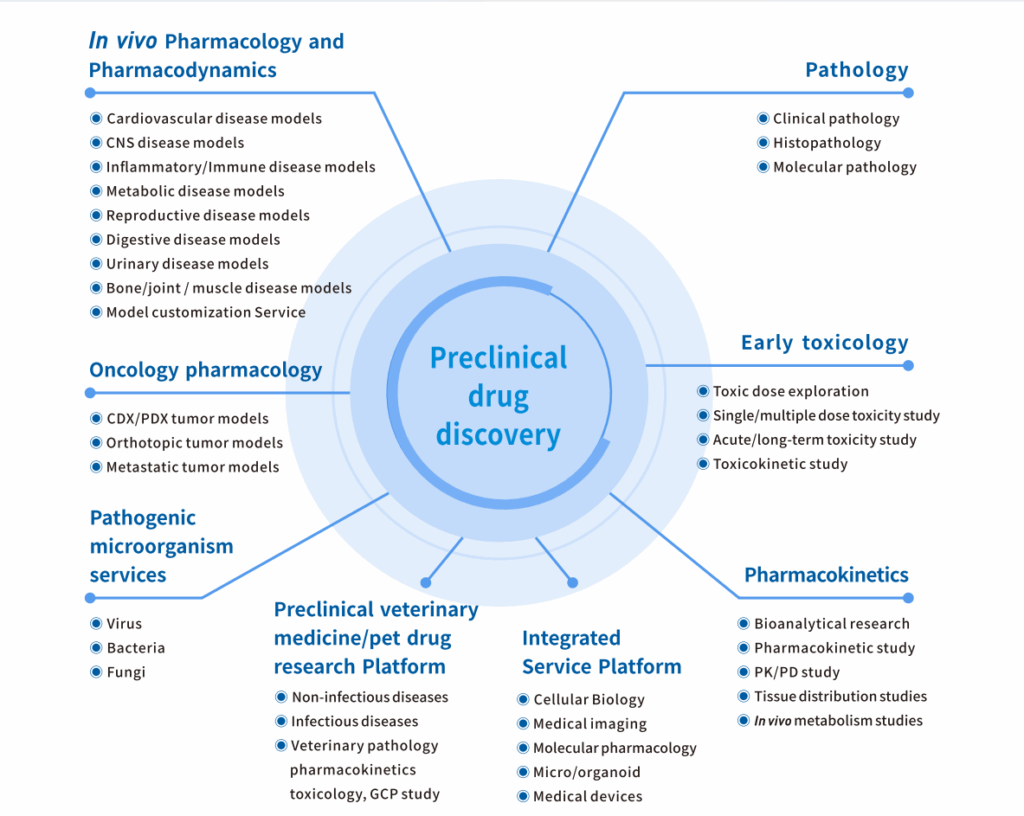
Which In Vivo Pharmacology and Oncology Services Support Efficacy Evaluation?
KCI BioTech’s in vivo pharmacology and pharmacodynamics services cover non-tumor disease models, including metabolic and kidney diseases among others.. Its oncology pharmacology services list cell-derived xenograft (CDX), patient-derived xenograft (PDX), orthotopic, and metastatic tumor models.
These options help R&D teams consider models relevant to their hypothesis. Selection should depend on the drug’s mechanism, research question, and each model’s limitations.
How Can Pathology, Pharmacokinetics, and Toxicology Complement Efficacy Data?
KCI BioTech lists pathology, early toxicology, and pharmacokinetics among its service categories. Combining these assessments can help researchers investigate tissue-level responses, drug exposure, and potential toxicity alongside efficacy.
Before commissioning work, teams should confirm the proposed design, analytical methods, reporting deliverables, and applicable quality standards. KCI BioTech’s integrated service platform provides a starting point for discussing how multiple preclinical assessments could fit into one development plan.
Explore KCI BioTech’s integrated preclinical service platform to discuss how multiple assessments may fit into a development plan.
What Should Researchers Take Away When Assessing Preclinical Drug Efficacy?
Drug efficacy assessment is most informative when researchers combine relevant animal models, measurable endpoints, reliable experimental design, and supporting pharmacological data. No single result establishes a candidate’s full therapeutic potential.
Teams should select a model that addresses the biological question; define endpoints and analysis methods in advance; interpret efficacy alongside exposure and safety; document limitations; and choose a preclinical CRO whose verified capabilities match study requirements.
With clear objectives and coordinated evidence, teams can make informed decisions about whether a drug candidate warrants further investigation.
Before moving forward, confirm that the evidence answers three questions: Did the candidate produce the intended effect? Was the result reliable? Do exposure and safety findings support further investigation?