Preclinical drug development hinges on rigorous, regulatory-aligned safety and toxicology evaluation, serving as the critical gateway to successful Investigational New Drug (IND) submissions and safe clinical trial progression.
For biotech startups, mid-sized pharmaceutical enterprises, and global drug developers, fragmented preclinical testing workflows—including disjointed toxicology studies, isolated ADME analysis, and inconsistent regulatory data collation—often lead to delayed project timelines, unreliable safety datasets, and elevated risks of clinical trial failure or regulatory rejection.
Integrated drug safety and toxicology services streamline the entire preclinical safety assessment lifecycle, unifying exploratory toxicity screening, GLP-compliant pivotal studies, toxicokinetic analysis, safety pharmacology testing, and regulatory data compilation into a single, cohesive solution.
This all-in-one model eliminates workflow gaps to a certain extent., standardizes data quality, and delivers decision-ready safety insights to support candidate screening, risk mitigation, and seamless transition from early discovery to first-in-human trials.

Why Is Integrated Drug Safety Important in Preclinical Research?
What Does Preclinical Research Need to Establish Before Clinical Trials?
Preclinical research must generate evidence on pharmacology, exposure, and potential toxicity before a drug candidate enters human testing.
The U.S. Food and Drug Administration (FDA) describes preclinical research as laboratory and animal testing used to answer basic safety questions, including dosing and toxicity. ICH M3(R2) likewise places pharmacology, pharmacokinetic, toxicokinetic, and toxicity information within nonclinical development.
Why Can Fragmented Preclinical Studies Create Development Challenges?
Fragmented studies can make it harder to connect efficacy, exposure, pathology, and safety findings because each dataset may be generated under a different study design. For R&D directors, the practical issue is not simply how many studies are completed, but whether the evidence can be interpreted together when selecting candidates, doses, and next-stage studies.
Which Preclinical Contract Research Services Support Drug Safety Evaluation?
How Do Pharmacology and Pharmacodynamics Inform Drug Development?
Pharmacology and pharmacodynamics (PD) studies help determine whether a candidate produces the intended biological effect and clarify its relationship with the therapeutic target. ICH M3(R2) notes that primary PD studies can investigate a substance’s mode of action and contribute to dose selection.
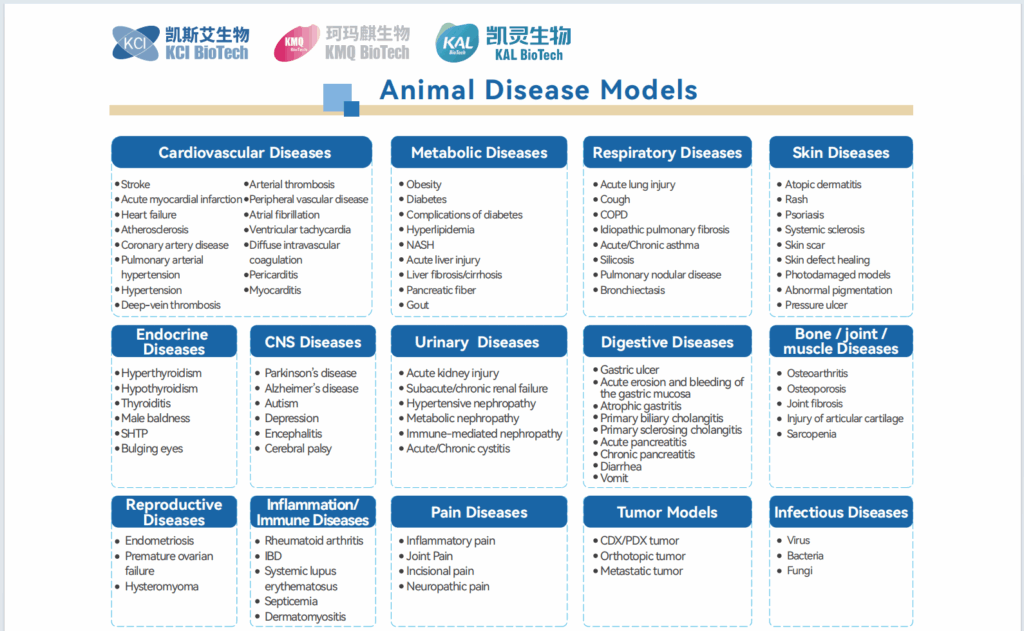
KCI BioTech‘s in vivo platform covers multiple disease areas and animal models for in vivo pharmacology and PD evaluation.
How Do Pharmacokinetics and Toxicology Support Safety Assessment?
Pharmacokinetics (PK) describes how a drug is absorbed, distributed, metabolized, and excreted, while toxicology examines potentially harmful effects. These datasets answer different questions but become more useful when exposure and toxicity findings are interpreted together.
KCI BioTech’s early toxicology platform provides non-GLP toxicity assessment, including dose exploration, acute and long-term studies, local toxicity, and toxicokinetics.
When Are Pathology and Disease Models Needed?
Disease models and pathology are useful when R&D teams need evidence that connects treatment response with biological changes in tissues or organs.
KCI BioTech provides disease models across areas including cardiovascular, metabolic, inflammatory, CNS, respiratory, skin, and oncology research, while its pathology platform supports tissue processing, staining, imaging, and morphological description.
How Can a Preclinical CRO Integrate Different Research Stages?
What Can an Integrated Preclinical Service Platform Connect?
An integrated platform can connect pharmacodynamics, toxicology, DMPK, imaging, and other research capabilities within a coordinated preclinical workflow.
KCI BioTech describes its integrated service platform as combining medical imaging, medical-device research, and micro/organoid modeling with pharmacodynamics, toxicology, and DMPK resources to support research from early development through preclinical studies.
When Should Pharmaceutical R&D Teams Consider an Integrated CRO?
An integrated CRO can be considered when a program requires several complementary study types and the R&D team needs consistent coordination across them. This approach is particularly relevant when model selection, dosing, exposure, pathology, and safety questions need to inform one another rather than being treated as isolated work packages.
How Does KCI BioTech Support Integrated Preclinical Drug Research?
What Preclinical CRO Services Does KCI BioTech Provide?
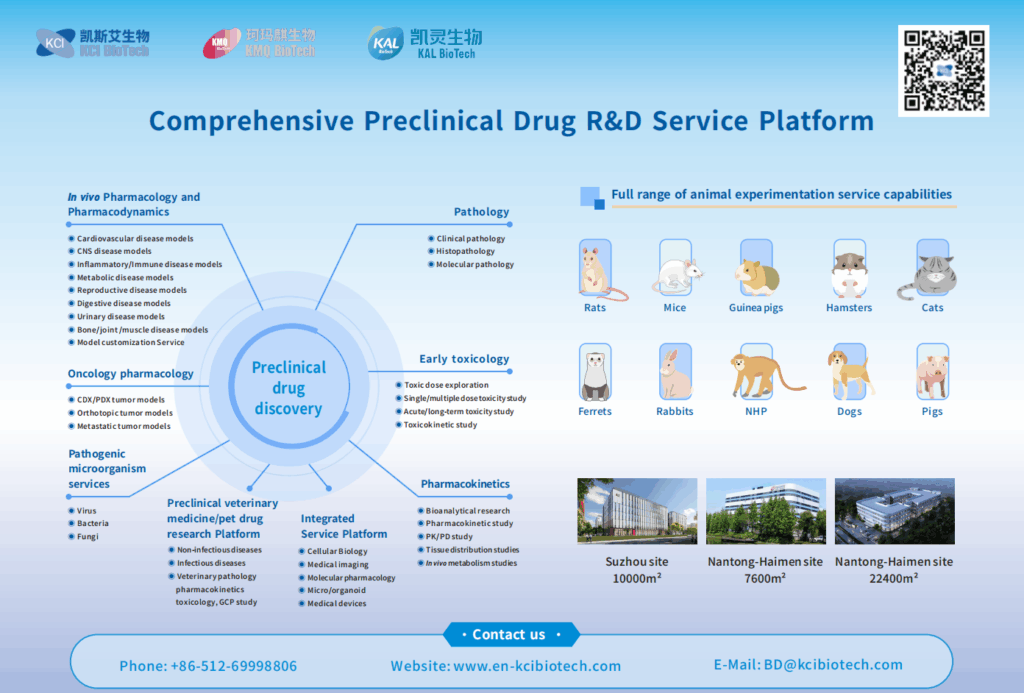
KCI BioTech is a full service preclinical CRO that provides a broad preclinical contract research services portfolio covering in vivo pharmacology and PD, oncology pharmacology and PD, pathogenic microorganism services, pathology, early toxicology, pharmacokinetics, integrated services, and preclinical veterinary medicine and pet drug research.
Their facilities cover more than 40,000 m² and support multiple species, 500+ different disease animal models, and pathogen research involving 100+ microorganisms.
How Do KCI BioTech Services Support Drug Safety and Toxicology Research?
The service portfolio allows a project to combine efficacy-oriented models with safety-focused investigations when the development plan requires both.
For example, KCI BioTech’s infectious-disease platform includes BSL-2 and ABSL-2 facilities and viral, bacterial, and fungal disease models, while its early toxicology platform supports non-GLP safety assessment before later GLP studies.
What Should R&D Teams Consider When Selecting Preclinical Services?
How Should Pharmaceutical Companies Match Services to Development Goals?
R&D teams should first define the decision the study must support, then select models and services around that decision. A program focused on efficacy may prioritize disease models and PD endpoints, whereas candidate selection may require stronger attention to exposure, toxicology, pathology, or dose exploration.
Why Does Data Continuity Matter Across Preclinical Studies?
Data continuity matters because safety interpretation depends on context: dose, exposure, biological response, and tissue findings should be considered together.
When selecting preclinical contract research services, R&D directors can therefore evaluate not only individual capabilities but also how readily the CRO can coordinate complementary studies and deliver connected evidence.
Conclusion: How Can Integrated Preclinical Services Support Drug Development?
Integrated preclinical services streamline the transition from early discovery to clinical candidate selection by unifying pharmacokinetic, toxicological, and efficacy data within a single operational framework.
By leveraging platforms that combine in vivo pharmacology, pathology, and safety assessment, pharmaceutical R&D teams can reduce logistical friction and accelerate decision-making.
KCI BioTech’s comprehensive infrastructure, including its extensive disease model library and specialized facilities for infectious disease and toxicology, exemplifies how coordinated service delivery enhances the reliability of preclinical evidence.
Ultimately, selecting a partner capable of integrating these diverse research stages ensures that critical safety and efficacy insights are generated concurrently, supporting more robust and efficient drug development pipelines.
Sources
KCI BioTech — About Us: https://www.en-kcibiotech.com/about-us/
KCI BioTech — In Vivo Pharmacology & Pharmacodynamics CRO: https://www.en-kcibiotech.com/product-category/in-vivo-pharmacology-and-pharmacodynamics/
KCI BioTech — Early Toxicology: https://www.en-kcibiotech.com/product-category/early-toxicology/
KCI BioTech — Integrated Service Platform: https://www.en-kcibiotech.com/product-category/integrated-service-platform/
KCI BioTech — Infectious Disease CRO Services: https://www.en-kcibiotech.com/product-category/pathogenic-microorganism-services-platform/
KCI BioTech — Histopathology: https://www.en-kcibiotech.com/product/histopathology/
FDA — Step 2: Preclinical Research: https://www.fda.gov/patients/drug-development-process/step-2-preclinical-research
ICH M3(R2) — Guidance on Nonclinical Safety Studies: https://database.ich.org/sites/default/files/M3_R2__Guideline.pdf
