
Female mice are widely used in Alzheimer’s disease (AD) research because biological sex can influence disease pathology, progression, immune responses, and treatment outcomes. With women accounting for nearly two-thirds of people living with AD in the United States, understanding sex-specific biology is an important consideration in preclinical research.
Female mouse models help researchers investigate mechanisms involving ovarian hormones, neuroinflammation, microglial activity, amyloid-beta and tau pathology, and synaptic function. For pharmaceutical R&D, including female models can reveal biological and treatment effects that may be missed in male-only studies, while the choice of sex should remain aligned with the specific research question, disease model, and translational goal.

Why female mice should be used in Alzheimer’s disease (AD) research?
Female mice are used because biological sex can influence Alzheimer’s-related pathology, behavior, and treatment responses. Alzheimer’s disease (AD) research increasingly treats sex as an important experimental variable rather than assuming male and female animals are biologically interchangeable.
For pharmaceutical R&D teams, this matters because studies that include female animals can reveal biological differences that may not appear in male-only experiments. The decision to use female mice should still be tied to the research question, model characteristics, and intended translational endpoint.
| Research consideration | Why it matters |
| Sex | Biological differences can affect disease phenotypes |
| Disease mechanism | Different models reproduce different AD features |
| Treatment testing | Responses may vary between male and female animals |
What Types of Alzheimer’s Disease Mouse Models Are Used?
Different mouse models reproduce different aspects of AD, so researchers should select a model according to the mechanism and endpoint they need to investigate.
Common approaches include transgenic, knock-in, injection, and neuroinflammation-related models. Transgenic models have historically focused heavily on amyloid-related mechanisms, while newer knock-in approaches can introduce disease-associated genetic changes without relying on the same degree of transgene overexpression.
How Do Amyloid and Tau Models Differ?
Amyloid-focused models are useful for investigating β-amyloid (Aβ) accumulation and related pathological processes, whereas tau models address tau-associated pathology. Some newer models attempt to incorporate multiple pathological features.
No single model reproduces every feature of human AD. Researchers therefore need to understand each model’s specific strengths and limitations before using it to evaluate a candidate therapy.
Model-selection aid: match the model to the mechanism and endpoint before choosing the study design.
What Are the Limitations of Alzheimer’s Disease Mouse Models?
The main limitation is that mouse models cannot reproduce the full biological complexity of human Alzheimer’s disease.
Human AD involves interacting factors including aging, genetics, amyloid pathology, tau pathology, neuroinflammation, neuronal dysfunction, and other systemic influences. Reviews have identified quantitative, qualitative, temporal, and context-dependent differences between commonly used mouse models and human disease.
This does not make mouse studies irrelevant. Instead, positive animal results should be interpreted within the biology and limitations of the selected model rather than treated as direct evidence of clinical efficacy.
| Potential issue | Practical response |
| Model captures selected pathology | Match the model to the target mechanism |
| Limited human translation | Use multiple relevant endpoints |
| Different disease trajectories | Interpret results within model biology |
How Can a CNS CRO Support Alzheimer’s Disease Research?
A CNS CRO can help pharmaceutical R&D teams connect disease-model selection with controlled in vivo pharmacology and pharmacodynamic evaluation.
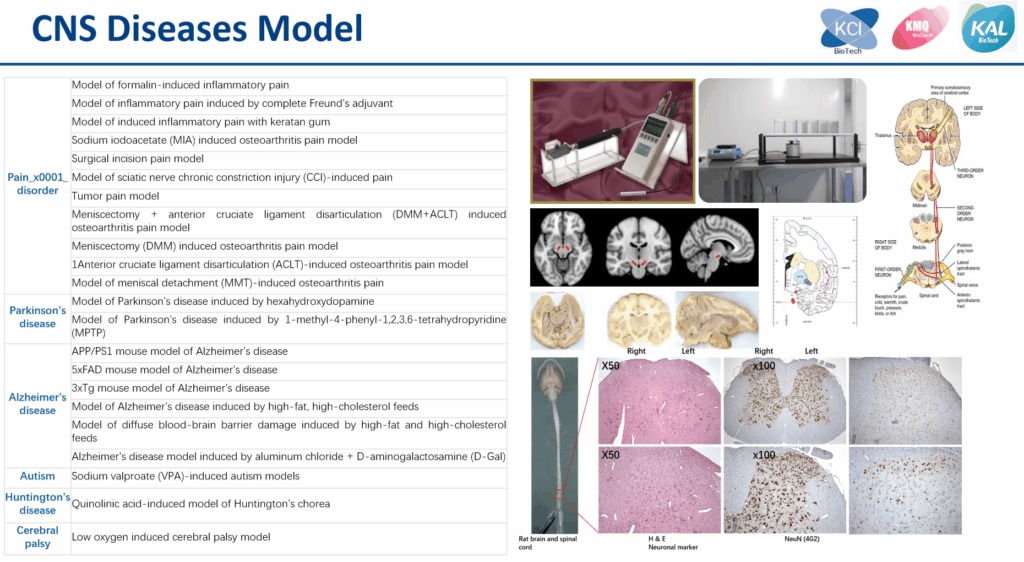
KCI BioTech’s official in vivo pharmacology and pharmacodynamics platform includes CNS disease models. Its broader preclinical services also cover pathology, pharmacokinetics, early toxicology, and integrated research support, allowing teams to connect individual study findings with broader preclinical evidence.
For an AD program, the workflow can begin by defining the mechanism and endpoint, selecting a suitable animal model, and establishing the study design. In vivo pharmacology and pharmacodynamic data can then be interpreted alongside pathology and other preclinical findings.
KCI BioTech describes itself as a comprehensive preclinical CRO with more than 40,000 m² of facilities, multiple species, and more than 500 disease models. Its integrated service platform also combines medical imaging and micro/organoid modeling with other preclinical capabilities.
Suggested workflow: define mechanism → select model → establish endpoints → evaluate in vivo pharmacology/PD → integrate pathology and other evidence.
What Should Pharmaceutical R&D Teams Consider When Choosing a Mouse Model?
The most useful starting point is not “Which mouse model is best?” but “Which model best answers this specific research question?”
- Target mechanism;
- Primary endpoint;
- Sex considerations;
- Translational limitations;
- Follow-up evidence.
This approach helps R&D teams use animal models as targeted research tools rather than treating one model as a universal representation of AD.
Decision sequence: mechanism → endpoint → sex → translational relevance → integration with other preclinical evidence.
Conclusion: Why Does Careful Model Selection Matter?
Female mice can provide important biological information in Alzheimer’s disease research, but sex is only one consideration when selecting an experimental model. Researchers also need to consider the disease mechanism, pathological features, study endpoints, and the degree to which a model reflects specific aspects of human disease.
For pharmaceutical R&D teams, alzheimer’s disease mouse models are most useful when their characteristics are matched deliberately to the development question. A model designed to investigate amyloid pathology may not answer the same questions as one focused on tau, neuroinflammation, or behavioral changes. Therefore, model selection should be defined before study execution rather than treated as a standardized step.
A specialized CNS CRO, like KCI BioTech, can support this process by connecting appropriate disease models with in vivo pharmacology, pharmacodynamics, pathology, and other preclinical assessments. This integrated approach can give development teams a more structured evidence base for deciding which findings warrant further
Sources
- KCI BioTech — About Us: https://www.en-kcibiotech.com/about-us/
- KCI BioTech — In Vivo Pharmacology and Pharmacodynamics: https://www.en-kcibiotech.com/product-category/in-vivo-pharmacology-and-pharmacodynamics/
- KCI BioTech —CNS Disease:https://www.en-kcibiotech.com/product-category/in-vivo-pharmacology-and-pharmacodynamics/cns-diseases/
- KCI BioTech — Pathologies: https://www.en-kcibiotech.com/product-category/pathologies/
- KCI BioTech — Pharmacokinetics: https://www.en-kcibiotech.com/product-category/pharmacokinetics/
- KCI BioTech — Early Toxicology: https://www.en-kcibiotech.com/product-category/early-toxicology/
- KCI BioTech — Integrated Service Platform: https://www.en-kcibiotech.com/product-category/integrated-service-platform/
- PubMed — Alzheimer’s disease mouse models and sex-specific considerations: https://pubmed.ncbi.nlm.nih.gov/38462606/
- PubMed — Transgenic mouse models of Alzheimer’s disease: https://pubmed.ncbi.nlm.nih.gov/31532917/
- PubMed — Limitations and challenges of Alzheimer’s disease mouse models: https://pubmed.ncbi.nlm.nih.gov/39329365/
- PubMed — Translational challenges in Alzheimer’s disease models: https://pubmed.ncbi.nlm.nih.gov/22458501/
- NIH/NIA— 2026 Alzheimer’s Disease and Related Dementias Research Progress Report:https://www.nia.nih.gov/about/2026-nih-alzheimers-disease-and-related-dementias-research-progress-report-advances-and?utm_source=chatgpt.com